
How to Analyse Your Chess Games and Actually Improve (Step-by-Step Method)
June 8, 2026 · ChessPivot · Guide
Analysing your chess games is the habit that separates players who stagnate from those who improve consistently. Between 800 and 1400 ELO, the vast majority of lost points does not come from poor opening preparation or subtle strategic misjudgement — it comes from repeated tactical mistakes, often the same ones, game after game. Systematic post-mortem analysis is the most direct way to become aware of those patterns and correct them.
This guide offers a six-step protocol you can apply immediately, whether you play online or over the board with a physical clock.
Why Analysing Games Beats Simply Playing More
Playing lots of games is naturally motivating, but repeating the same patterns without examining them fixes nothing. A player who runs through ten blitz games without analysis mainly practises moving quickly — reinforcing good reflexes and bad habits in equal measure.
Analysis, even a short one, breaks that cycle. It forces you to name what happened, to distinguish a tactical error from a plan error, and to formulate a rule you can apply in your next game.
The game you just lost contains more useful information than ten randomly chosen puzzles.
Data from the Lichess database (millions of games) backs this up: one-move blunders and premature resignations account for the dominant share of losses in the 800–1200 ELO bracket. These are not pawn-structure problems or endgame technique issues — they are tactical blind spots, detectable through analysis.
Step 1 — Replay the Game from Memory Before Opening an Engine
This is the most neglected step, and yet the most formative. Before launching Stockfish or any other engine, replay the key moments of the game from memory — mentally, or on a physical board.
- Note the moments where you hesitated.
- Identify the moves you were uncertain about when you played them.
- Pinpoint the subjective turning point: when did you sense the position was shifting?
This exercise trains your position evaluation and your feel for candidate moves. It lets you approach the engine with hypotheses to test, rather than passively watching green and red arrows scroll by.
Step 2 — Mark the Critical Moments Without the Engine
Once you have replayed the game mentally, open it in your software or online interface — but do not activate the engine yet. Browse through the moves and bookmark (or annotate manually) the following:
- Positions where you played or considered a sacrifice.
- Moments where your opponent surprised you.
- Squares or pieces that felt dangerous or hard to manage.
- The move you consider your main mistake.
This manual selection of critical moments is valuable: it maps your actual understanding of the game. If the engine later finds a massive error on a move you had not even flagged, that is a strong signal about your current blind spot.
Step 3 — Run the Engine Only on the Key Moments
Running a full engine analysis on all 50 moves of a game and reading every centipawn swing is counterproductive. There is no reliable correlation between "reading lots of engine lines" and "improving quickly." What matters is the quality of your dialogue with the suggested variations.
Proceed as follows:
- Activate the engine only on the five to ten moments you flagged in Step 2.
- For each flagged error, let the engine show you the best move and the main continuation.
- Ask yourself: why is this move better? Which tactical motif or positional principle does it exploit?
- If you do not understand the variation, look for a shorter line; ask yourself whether the motif is a fork, a pin, a skewer, a discovered attack, and so on.
This active dialogue with the engine is what turns analysis into genuine learning.
Step 4 — Recognise the Tactical Motifs You Missed
The vast majority of mistakes between 800 and 1400 ELO are missed tactical opportunities — either you failed to execute a winning tactic when you had the chance, or you did not see your opponent’s. Here are three concrete examples drawn from real games (positions anonymised).
Example A — Black to move
- Black to move. Fork: Qh4+ — the queen on h4 attacks the king (e1) and a knight (e4) at once.
- Real line: Qh4+ g3 Qxe4 Qd5 — Black wins a piece.
- Takeaway: a loose piece or an exposed king invites a fork — keep your pieces defended and your king safe.
In this position, it is Black’s turn. The opponent’s camp has left two targets simultaneously accessible. Failing to spot this opportunity means letting a decisive material advantage slip — a typical consequence of the misstep that created this configuration in the first place.
Example B — White to move
- White to move. Fork: Bd3+ — the bishop on d3 attacks the king (g6) and a rook (c2) at once.
- Real line: Bd3+ Kg7 Bxc2 f5 — White wins the exchange or a rook.
- Takeaway: a loose piece or an exposed king invites a fork — keep your pieces defended and your king safe.
Here, White has a move that simultaneously attacks two opposing pieces along an open diagonal. This type of bishop fork — less intuitive than a knight fork — is frequently missed in this ELO range.
Example C — White to move
- White to move. Fork: Ng6 — the knight on g6 attacks the queen (e7) and a rook (h8) at once.
- Real line: Ng6 Rxh4 Nxe7 Rxe4 — White wins the exchange or a rook.
- Takeaway: a loose piece or an exposed king invites a fork — keep your pieces defended and your king safe.
In this configuration, White can place a knight on an ideal central square, simultaneously threatening a heavy piece and a rook. The candidate move requires calculating just two half-moves ahead — a depth of calculation that is entirely achievable with practice.
These three examples illustrate a fundamental principle: tactical mistakes do not appear from nowhere — they are made possible by a structural weakness or an imprecise move by the other side. During your analysis, always look for what, in the preceding position, made the tactic possible.
Step 5 — Categorise Your Mistakes and Keep a Journal
Spotting a mistake is useful. Categorising it is transformative. Keep an analysis journal (a plain text file or a notebook is fine) in which you record, for each analysed game:
- Type of error: tactical (missed motif), positional (poor plan, passive piece), or opening (delayed development, unfortunate departure from theory).
- Phase of the game: opening, middlegame, endgame.
- Recurrence: is this the first time you have made this type of mistake, or is it a pattern?
After ten analysed games, read back through your journal. Two or three dominant categories will emerge. Those are your real weaknesses — the ones on which to focus your puzzle work and study.
Here is what an analysis dashboard looks like in a dedicated tool, showing move-quality breakdown, accuracy by phase, and recurring weaknesses:
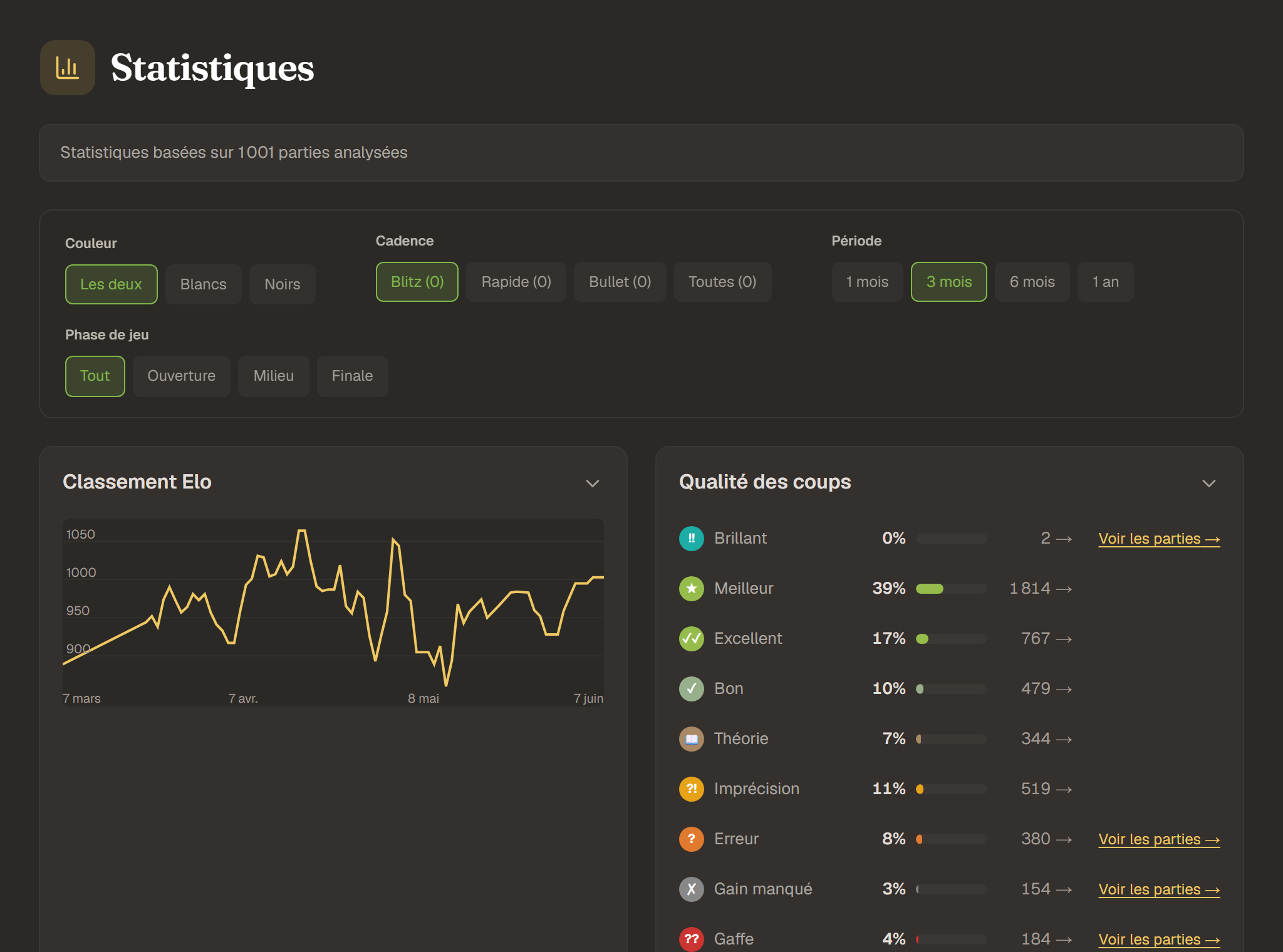
This kind of aggregated view across multiple games is far more instructive than a one-off analysis: it reveals the trends that are invisible game by game.
Step 6 — Set a Concrete Improvement Goal Before Your Next Game
Analysis only has value if it leads to an intention. Before starting your next game, formulate a precise goal drawn from your most recent analysis.
Examples of actionable goals:
- "Before every move, I check whether my opponent has a knight fork available."
- "I make sure my pieces are developed and my king is safe before launching an attack."
- "I do not play a move that leaves a piece hanging without double-checking."
These micro-goals are infinitely more effective than vague resolutions like "play better" or "calculate further." They focus your attention on a specific, measurable behaviour that you can track in the next game.
Common Mistakes in Game Analysis
Even players who analyse regularly fall into certain methodological traps.
- Analysing only losses. Wins contain mistakes too — sometimes your opponent simply failed to punish you. Analyse your victories as well.
- Letting the engine think for you. Watching variations scroll past without asking why they are good produces no understanding.
- Focusing on the opening at the expense of the middlegame. Between 800 and 1400 ELO, virtually all decisive decisions happen in the middlegame, not in the first fifteen moves.
- Long sessions, infrequently. A twenty-minute analysis immediately after the game beats a one-hour session the next day — the emotional memory of the game is still fresh.
- Ignoring your opponent’s moves. Your error analysis is incomplete if you do not understand what your opponent could (or should) have played instead.
- Confusing result with quality. Winning a poorly played game does not mean it does not deserve analysis.
Combining Game Analysis with Puzzle Training
Game analysis and tactical exercises (puzzles) are complementary, not interchangeable. Puzzles train pattern recognition in idealised conditions; game analysis trains you to spot those same patterns in messy positions, with visual noise and time pressure.
The optimal sequence looks like this:
- Analyse a game → identify a missed tactical motif (e.g., discovered attack).
- Run a targeted puzzle session focused on that exact motif.
- In your next game, pay special attention to positions where that motif might arise.
This "analyse → targeted exercise → application" cycle is far more effective than doing random puzzles with no connection to your actual weaknesses.
Conclusion
Analysing your chess games is not reserved for advanced club players: it is a practical skill, accessible from beginner level, that produces visible results within a few weeks when applied consistently. The six steps described here — replay from memory, mark critical moments, engage actively with the engine, recognise the motifs, categorise your mistakes, and set a micro-goal — form a complete protocol adaptable to any time control or playing schedule.
If you want to centralise this process and track your progress over time, ChessPivot offers a dedicated analysis tool built specifically for players in this ELO range.
Read also
Frequently asked questions
- How long should you spend analysing a chess game?
- For a player between 800 and 1400 ELO, an effective analysis session lasts between 15 and 30 minutes per game. What matters is not the length but the consistency: analysing shortly after the game, while the intent behind each move is still fresh, is more formative than a lengthy session days later. Focus on five to ten key moments rather than running every single move through the engine.
- Do you absolutely need an analysis engine to improve?
- No, an engine is not essential, especially at beginner and intermediate levels. Replaying the game from memory, identifying critical moments, and discussing with a stronger partner are all highly effective methods. An engine becomes useful when used in a targeted way — only on moves flagged as doubtful — and when you genuinely try to understand why it suggests what it does, rather than just memorising its moves.
- What is the difference between a tactical mistake and a positional mistake in analysis?
- A tactical error is a move that allows the opponent to win material or gain a decisive advantage in just a few moves, usually through a concrete motif such as a fork, pin, or skewer. A positional error is a move that does not immediately lose a piece but gradually worsens the position: a misplaced piece, an unnecessarily created weak pawn, a development lag. Both types of mistakes deserve to be logged separately in your journal, as they call for different training corrections.
- Should you analyse every game, even blitz or bullet games?
- You do not need to analyse every blitz or bullet game in detail: at those time controls, mistakes are often driven by time pressure rather than genuine misunderstanding. That said, if the same type of error keeps appearing in your fast games, make a note of it. Reserve your in-depth analysis for standard or classical time controls, where your moves more accurately reflect your actual understanding of the position.
- How can you tell if your level of analysis is good enough to help you improve?
- A reliable indicator is your ability to anticipate the engine’s suggestions. If, after a few weeks of regular analysis, you start guessing the best move before activating the engine on at least a third of critical positions, that is a concrete sign of progress. Another indicator is the quality of your manual annotations: if your comments become more precise and relevant over time — naming motifs, identifying the opponent’s plans — your analysis is doing its job. The goal is not analytical perfection but gradual, measurable improvement.